
The SAVER System: A Budget Workbook for People Who Are Already Good at Saving


By Manny Alfaro | Family Finance Warriors
Some families need help learning how to save. Others have almost the opposite problem.
They save consistently. They watch their checking and savings balances carefully. They hesitate before spending. They may have thousands of dollars sitting in cash—but still aren't sure how much is actually enough.
That is the problem the Family Finance Warriors SAVER System was built to address.
Instead of another challenge telling families to stop eating out, stop spending, or save every available dollar, SAVER asks a different question:
What is this money actually for?
The system's core rule is simple:
Give cash a home. Require Joy.
The finished SAVER workbook includes 12 worksheets, a START HERE guide, US Letter and A4 versions, and both printable and fillable PDFs. Buyers can print the worksheets and write by hand or type directly into the fillable version.
The current system and its Target-versus-Assigned rules follow the locked SAVER v1.1.1 framework.

Why Another Budget System?
Traditional budgeting often concentrates on one question: Where did the money go?
SAVER adds another:
When does saving stop being the goal and start becoming indecision?
That distinction matters because financial well-being is not only about accumulating the largest possible bank balance. The Consumer Financial Protection Bureau describes financial well-being as having control over day-to-day finances, being able to absorb a financial shock, progressing toward goals, and having enough financial freedom to make choices that allow you to enjoy life.
That last part is important.
Security matters. So does living.
That is why SAVER intentionally includes both a Buffer for protection and a required Joy category for the present.
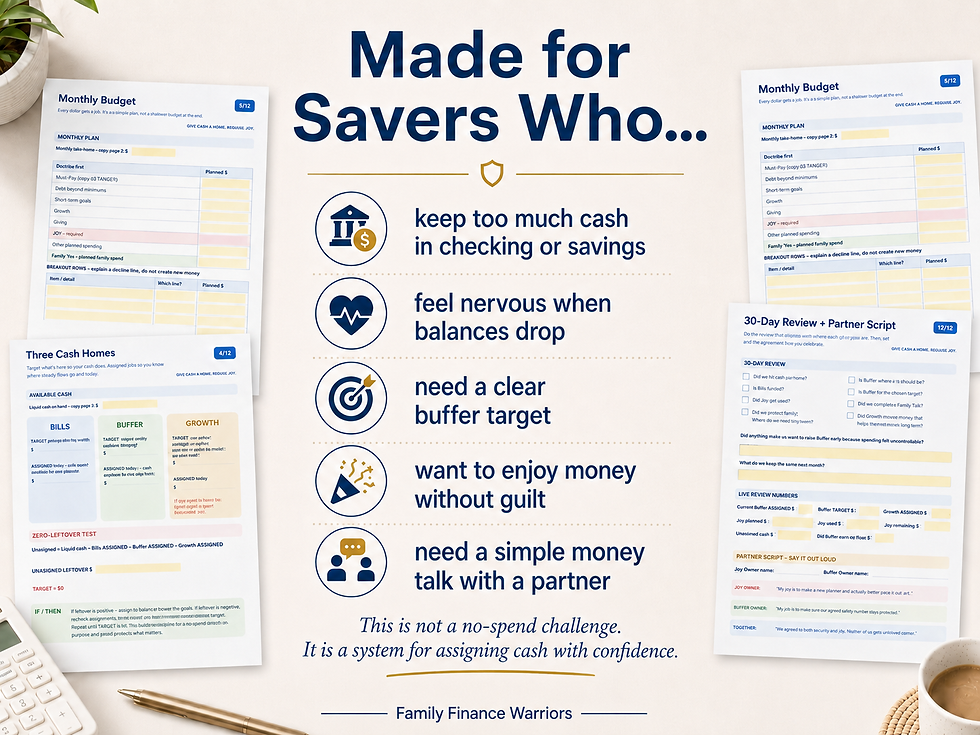
The system is especially designed for people who already have the saving habit but may still keep too much money unlabeled, feel nervous when account balances fall, or struggle to spend on something enjoyable even when it fits comfortably within their plan.
The Three Cash Homes: Bills, Buffer and Growth
The centerpiece of SAVER is the Three Cash Homes.
Every dollar of liquid cash should eventually have a clear purpose. Instead of one giant checking or savings balance that means five different things, SAVER separates the purpose of cash into three understandable homes.
Three Cash Homes Chart
Cash Home | What It Means | Target | Main Question |
Bills | Cash protecting essential monthly obligations | About 30 days of Must-Pay expenses | Can we cover the bills that must be paid? |
Buffer | Your deliberately selected household safety reserve | Your chosen emergency/safety target | How much cash helps this household absorb a financial shock? |
Growth | Cash beyond Bills + Buffer that no longer needs to remain idle | Whatever remains after the first two homes are adequately funded | What should this money do next? |
There is also an important fourth number—but it is not another cash home:
Unlabeled Leftover.
The target for unlabeled cash is:
$0
That does not mean your checking account needs to contain $0. It means the cash sitting there should have a known job.

Target Is Not the Same as Assigned
This may be the most important part of the system.
SAVER separates a TARGET from an ASSIGNED amount.
A target tells you where you are trying to go.
Assigned tells you how much cash you actually have parked there today.
Imagine a sample family with:
Monthly take-home pay of $6,400, total liquid cash of $2,900, and Must-Pay expenses of $4,200 per month.
Their Bills TARGET is $4,200.
But they cannot assign $4,200 to Bills when they only possess $2,900.
Their Page 4 could therefore look like this:
Liquid cash: $2,900
Bills TARGET: $4,200
Bills ASSIGNED: $2,900
Buffer ASSIGNED: $0
Growth ASSIGNED: $0
The zero-leftover test becomes:
$2,900 − $2,900 − $0 − $0 = $0
Their Bills home is not fully funded yet, but every dollar they actually have has a home.
That is much more useful than pretending a financial target is the same thing as money already sitting in the bank.
How Much Should Go Into the Buffer?
There is no perfect emergency-fund number for every family.
Current Fidelity guidance suggests first building roughly $1,000 of emergency savings and then working toward approximately three to six months of essential expenses. The appropriate amount can vary based on dependents, income stability, insurance, employment risk and other circumstances.
SAVER uses that research as a planning reference, not as a command.
The worksheet begins with a starter-safety reference and uses three months of Must-Pay expenses as the SAVER default reference once that starter amount already exists.
But the household deliberately chooses its actual Buffer TARGET.
That is important because someone with a stable two-income household may reasonably feel comfortable at a different level than someone supporting a family on irregular income.
The goal is not to keep increasing the Buffer simply because watching a large savings balance feels good.
The goal is to decide what enough means—and then give money above that level another job.
Joy Is a Required Budget Line
This is where SAVER differs from many savings worksheets.
Joy is not leftover money.
It gets planned.
A conventional zero-based budget assigns a job to each dollar of take-home pay until nothing remains unassigned. Fidelity describes this basic approach as allocating regular expenses, discretionary spending and savings goals until income minus planned uses reaches zero.
SAVER uses that same useful budgeting logic but adds an important requirement:
JOY gets its own line.
Maybe Joy is a family dinner.
Maybe it is a hobby.
Maybe it is a movie, day trip, date night, book, concert or something just for you.
There is no universal Joy percentage.
The family decides the amount.
Then the Joy Calendar puts dates beside those dollars so the money becomes part of real life rather than a number continually transferred back into savings.
This idea is consistent with the CFPB's broader definition of financial well-being: financial security should coexist with the freedom to make choices that allow people to enjoy life.
There is also an important safety valve: if take-home income cannot currently cover Must-Pay expenses, Joy can be marked paused for that month.
Require Joy does not mean ignore financial reality.
It means that once reality allows it, living belongs in the plan too.

What Happens When You Have Too Much Cash?
This is another unusual part of SAVER.
Most savings products ask:
How can you save more?
SAVER also asks:
Should you still be saving this particular dollar as cash?
The Too Much Cash? page checks whether Bills are actually funded, whether the chosen Buffer is full, whether cash remains unlabeled, whether a workplace retirement match is being captured and whether expensive debt is sitting beside unnecessary idle cash.
If an employer offers a retirement-plan match, Fidelity currently recommends contributing enough to capture the full available match when practical.
The optional debt page also allows either the highest-interest-rate method or the debt snowball. The CFPB recognizes both approaches: highest-interest-first may reduce total interest costs, while snowballing smaller balances can provide faster visible progress.
SAVER does not choose one for you.
It requires you to choose one in writing.
Growth then becomes the next conversation.
The SAVER Growth page intentionally avoids individual stock picks and short-term market predictions. Its long-term rule is designed to keep the approach simple—for example, a diversified target-date approach or a simple broadly diversified portfolio selected according to the investor's circumstances.
Target-date funds are one example of this simpler structure: Vanguard notes that they typically provide diversification and automatically rebalance over time, although they still involve investment risk and are not appropriate for everyone.
The 12 SAVER Worksheets
The system walks through the same sequence each month instead of forcing families to build their own process from scattered budgeting pages:
Fear Number — identify the cash balance you are afraid to fall below before doing the math.
Snapshot — record take-home pay, liquid cash and workplace-match information.
Must-Pay + Buffer — calculate essential monthly expenses and choose a safety target.
Three Cash Homes — separate Targets from cash actually Assigned to Bills, Buffer and Growth.
Monthly Budget — give every dollar a job while making Joy a required category.
Joy Calendar — put dates beside planned Joy spending.
Family Yes — plan one meaningful family purchase or experience and see the safety numbers before and after.
Too Much Cash? — identify when continuing to accumulate idle cash may no longer be the next financial job.
Debt List — Optional — choose avalanche or snowball and direct extra debt payments intentionally.
Growth — review workplace matching and lock a simple long-term investing rule.
Kids Money Jars — teach Give, Save and Spend without eliminating the Spend jar.
30-Day Review + Partner Script — review Buffer, Growth, Joy and unlabeled cash together.
The Etsy version currently includes all 12 worksheets, a START HERE guide, US Letter and A4
formats, and both printable and fillable PDF versions.

Printable or Fillable: Use the Format That Works for You
Some people understand money better with a pen in their hand.
Others want everything on a laptop or tablet.
The SAVER Etsy bundle includes both.
The printable version is designed for writing by hand. The fillable PDF lets buyers type directly into compatible PDF fields, save their answers and print later if desired.
The fillable workbook is intentionally not an automatically calculating spreadsheet. It keeps the experience close to the worksheet system instead of turning it into complicated financial software.
For families who prefer automatic calculations, a spreadsheet-based version can remain a separate tool or upgrade rather than making the workbook itself harder to use.
Why Start With the Fear Number?
Because sometimes the number in your head is controlling the budget before the budget ever reaches paper.
Suppose someone has decided they must always have $20,000 in cash.
Why $20,000?
Maybe that number reflects real household risks.
Or maybe dropping below it simply feels uncomfortable.
Page 1 deliberately records the number before the Must-Pay and Buffer calculations appear.
Then the original Fear Number remains visible at the 30-day review.
The purpose is not to tell someone their fear is wrong.
It is to let the household compare the emotional number with the financial numbers without quietly changing the original answer.
What Is a “Family Yes”?
A Family Yes is one planned family expense that does not need to become a guilt exercise.
The worksheet asks what the family wants to do, why it matters, what it costs and what happens to the safety numbers afterward.
If the planned purchase leaves the agreed safety structure intact, the healthy result can simply be:
No, this did not destroy our financial safety. We can do it.
That may sound obvious, but for someone who has spent years becoming an excellent Saver, permission can sometimes be harder than the math.
What the SAVER System Is Not
SAVER is not designed around coupon sheets, no-spend months, extreme frugality, stock picking or guilt over everyday purchases.
It also is not intended to tell every family that the same Buffer, Joy amount, investment allocation or debt method is right for them.
It is a decision framework.
The purpose is to make four things visible:
What must be protected.
How much safety you deliberately chose.
What the remaining money should do.
What you are allowing your family to enjoy.
Frequently Asked Questions About the SAVER Budget Workbook
Is SAVER for people who are bad at saving?
Not necessarily. It is primarily designed for people who may already be good at saving but struggle to decide when their cash reserve is large enough or how much they can comfortably spend without guilt.
Do I have to keep three separate bank accounts?
No. The Three Cash Homes are purposes, not necessarily three separate financial institutions or accounts. Some people may choose separate accounts, while others may track the three assignments inside existing accounts.
Is Buffer the same as an emergency fund?
It serves a similar safety purpose. SAVER uses the word Buffer because the household deliberately selects the amount based on its own Must-Pay expenses and circumstances rather than treating one universal number as correct for everyone.
Why does Joy have to be in the budget?
Because SAVER treats present-day financial freedom as part of financial well-being rather than assuming every discretionary dollar should automatically become more savings. The household still chooses the amount and can pause Joy when essentials are not covered.
Where can I get the workbook?
The Family Finance Warriors SAVER System is available as an instant digital download from the FamilyBudgetWarriors Etsy shop. The listing includes five PDF files covering the
Shop the SAVER Budget Workbook on Etsy
Give Cash a Home. Require Joy.
Being good at saving is valuable.
But saving works better when you know what it is protecting.
Bills protect today.
Buffer protects against the unexpected.
Growth helps prepare for tomorrow.
Joy makes room for the life happening in between.
The SAVER System is designed to help families stop asking, “Can I save another dollar?” and start asking:
“What job should this dollar have?”
Save without freezing every dollar.
Family Finance Warriors
View the Printable + Fillable SAVER System on Etsy
Financial Disclaimer
The Family Finance Warriors SAVER System and this article are provided for financial organization and educational purposes only. They do not provide individualized financial, investment, tax, accounting or legal advice. Emergency savings, debt repayment, retirement contributions and investment choices should be evaluated based on your household's individual circumstances. Investing involves risk, including possible loss of principal.
About the Author
Manny Alfaro is the creator behind Family Finance Warriors and the owner of the FamilyBudgetWarriors Etsy shop. He develops practical family budgeting, saving and money-organization tools designed to turn complicated financial decisions into steps families can see, discuss and use.


Comments