
Best Kids Debit Cards and Credit-Building Cards in 2026

Updated: Jun 14
By Manny Alfaro | Family Finance Warriors
Helping Kids Learn Money Skills Before Adulthood
Most parents spend years teaching their children how to ride a bike, cross the street safely, and do well in school. Yet one of the most important life skills—managing money—is often left until adulthood.
By the time many young adults receive their first paycheck, they have never learned how to budget, save, invest, or avoid debt.
That is why kids debit cards and teen banking accounts have exploded in popularity. These tools allow parents to gradually teach financial responsibility while maintaining oversight and control.
Modern kids debit cards are far more than simple spending accounts. Many now include chore tracking, savings goals, investing tools, financial education lessons, and real-time parental controls.
In this guide, we'll compare the best kids debit cards and credit-building options available in 2026 and help parents determine which one fits their family's needs.
Why Kids Should Learn About Money Early
Research consistently shows that money habits begin forming during childhood.
Children who learn basic financial concepts early are more likely to:
Save money regularly
Avoid excessive debt
Build strong credit habits
Understand budgeting
Make smarter financial decisions as adults
A kids debit card allows children to gain real-world experience with money while parents maintain supervision.
Instead of simply handing over cash, parents can teach valuable lessons about earning, saving, spending, and giving.
What Parents Should Look For
Not all kids banking products are equal.
Before choosing a card, consider:
Monthly Fees
Some accounts are free while others charge monthly subscription fees.
Parental Controls
Look for features such as:
Spending limits
Merchant restrictions
Instant notifications
Card lock and unlock functions
Savings Tools
The best programs encourage long-term savings habits through goal tracking and automatic transfers.
Chore Management
Many platforms allow parents to connect chores with earnings.
Investing Features
Some programs introduce children to investing through stocks and ETFs.
Educational Resources
Financial literacy lessons can help children understand money concepts more effectively.
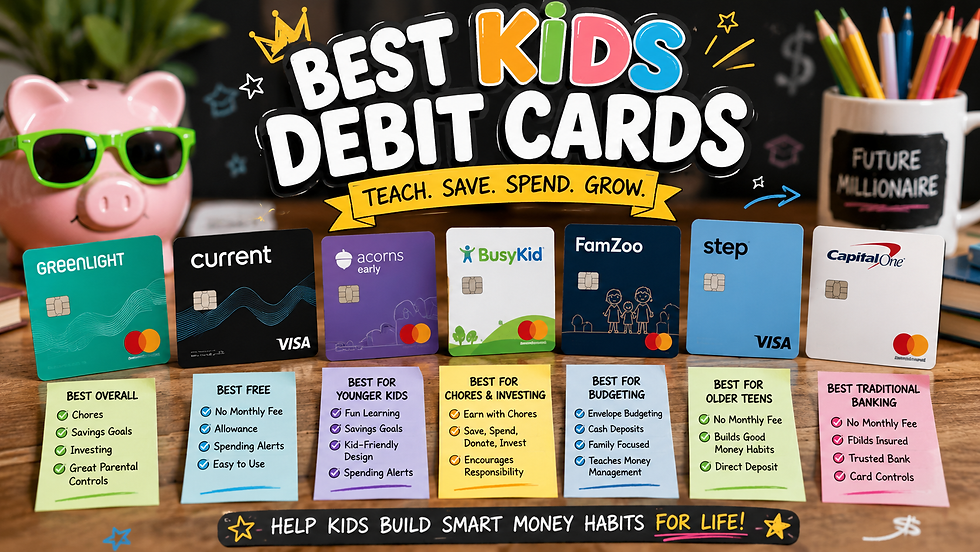
1. Greenlight – Best Overall Kids Debit Card
Greenlight is widely considered the most comprehensive financial platform for children and teens.
Parents can create spending categories, assign chores, automate allowances, track savings goals, and even introduce investing.
Pros
Outstanding parental controls
Real-time purchase notifications
Savings goal tracking
Investing opportunities
Chore management system
Multiple children supported
Cons
Monthly subscription fee
No physical bank branches
More expensive than some competitors
Best For
Families wanting the most complete money-management platform.
2. Current Teen Banking – Best Free Option
Current offers one of the strongest free options available for teenagers.
The platform provides spending controls, instant alerts, and allowance features without requiring monthly fees.
Pros
No monthly fees
Easy-to-use mobile app
Spending notifications
Teen-friendly design
Strong parental oversight
Cons
Limited investing tools
Fewer educational resources
Better suited for teens than younger children
Best For
Parents seeking a low-cost solution.
3. Acorns Early – Best for Younger Children
Formerly known as GoHenry, Acorns Early focuses heavily on financial education.
The platform combines spending tools with age-appropriate lessons that help younger children understand money concepts.
Pros
Excellent educational content
Child-friendly interface
Savings goals
Strong learning focus
Cons
Monthly fee
Limited advanced features
Costs increase with multiple children
Best For
Children ages 6 to 12.
4. BusyKid – Best for Chores and Investing
BusyKid takes a unique approach by helping children earn money through chores.
Kids can divide earnings among spending, saving, donating, and investing categories.
Pros
Excellent chore tracking
Investing opportunities
Donation features
Encourages earning before spending
Cons
Interface feels dated
Fewer parental controls
Smaller feature set
Best For
Families emphasizing responsibility and earning money.
5. FamZoo – Best Budgeting Education Tool
FamZoo focuses heavily on teaching budgeting skills.
Many parents appreciate its envelope-style budgeting approach that mimics real-world financial planning.
Pros
Strong budgeting tools
Supports cash management
Family-centered design
Educational focus
Cons
Less modern interface
Steeper learning curve
Requires more setup
Best For
Families serious about teaching budgeting fundamentals.
6. Step – Best for Older Teens
Step bridges the gap between teenage banking and adult financial life.
It introduces concepts related to credit-building while remaining simple and accessible.
Pros
No monthly fees
Popular among teens
Credit-building education
Direct deposit support
Cons
Limited parental features
Not ideal for younger children
Few educational tools
Best For
Teens preparing for adulthood.
7. Capital One MONEY Teen Checking
Parents who prefer traditional banking often choose Capital One.
The account offers strong security and basic parental oversight without subscription fees.
Pros
No monthly fees
FDIC-insured bank account
Trusted institution
Card controls available
Cons
Fewer educational features
No investing tools
Less engaging for kids
Best For
Families wanting a traditional banking experience.
Can Kids Have Credit Cards?
Most children cannot legally obtain their own credit card until adulthood.
However, many parents add older teenagers as authorized users on their own credit cards.
This strategy can help establish a credit history before the child turns 18.
Potential benefits include:
Building credit history
Learning responsible credit use
Understanding billing cycles
Improving future loan opportunities
Parents should monitor spending closely and only use this strategy with financially mature teens.
Teaching Kids Responsible Money Habits
A debit card alone will not teach financial responsibility.
Parents should use these opportunities to discuss:
Budgeting
Help children divide money among spending, saving, and giving.
Delayed Gratification
Teach children how saving can help them purchase larger items later.
Investing
Introduce concepts such as compound growth and long-term wealth building.
Charitable Giving
Encourage generosity alongside saving and spending.
Goal Setting
Help children save toward meaningful purchases.
These lessons can have a lifelong impact.
Which Card Is Best for Your Family?
There is no perfect card for every household.
Families with multiple children often prefer Greenlight because of its extensive features.
Budget-conscious families may favor Current or Step.
Parents focused on financial education may appreciate Acorns Early or FamZoo.
Families emphasizing chores and responsibility frequently choose BusyKid.
The best choice depends on your child's age, maturity level, and your family's financial goals.
Final Verdict
Teaching financial responsibility is one of the greatest gifts parents can provide.
The best kids debit cards help children learn budgeting, saving, investing, and spending while allowing parents to guide the process.
Comparison Table
Card | Best For | Monthly Fee | Investing | Chores | Parent Controls | Overall Rating |
Greenlight | Overall Best | $$ | Yes | Yes | Excellent | 9.5/10 |
Current | Free Banking | Free | No | Yes | Very Good | 9.0/10 |
Acorns Early | Young Kids | $$ | Limited | No | Very Good | 8.8/10 |
BusyKid | Chores | $ | Yes | Excellent | Good | 8.5/10 |
FamZoo | Budgeting | $$ | No | Yes | Good | 8.4/10 |
Step | Older Teens | Free | No | No | Fair | 8.3/10 |
Capital One MONEY | Traditional Banking | Free | No | No | Good | 8.2/10 |
The earlier children learn how money works, the better prepared they will be for financial success as adults.


Comments