
The Best Grocery Stores for Families in America (2026)


By Manny Alfaro | Family Finance Warriors
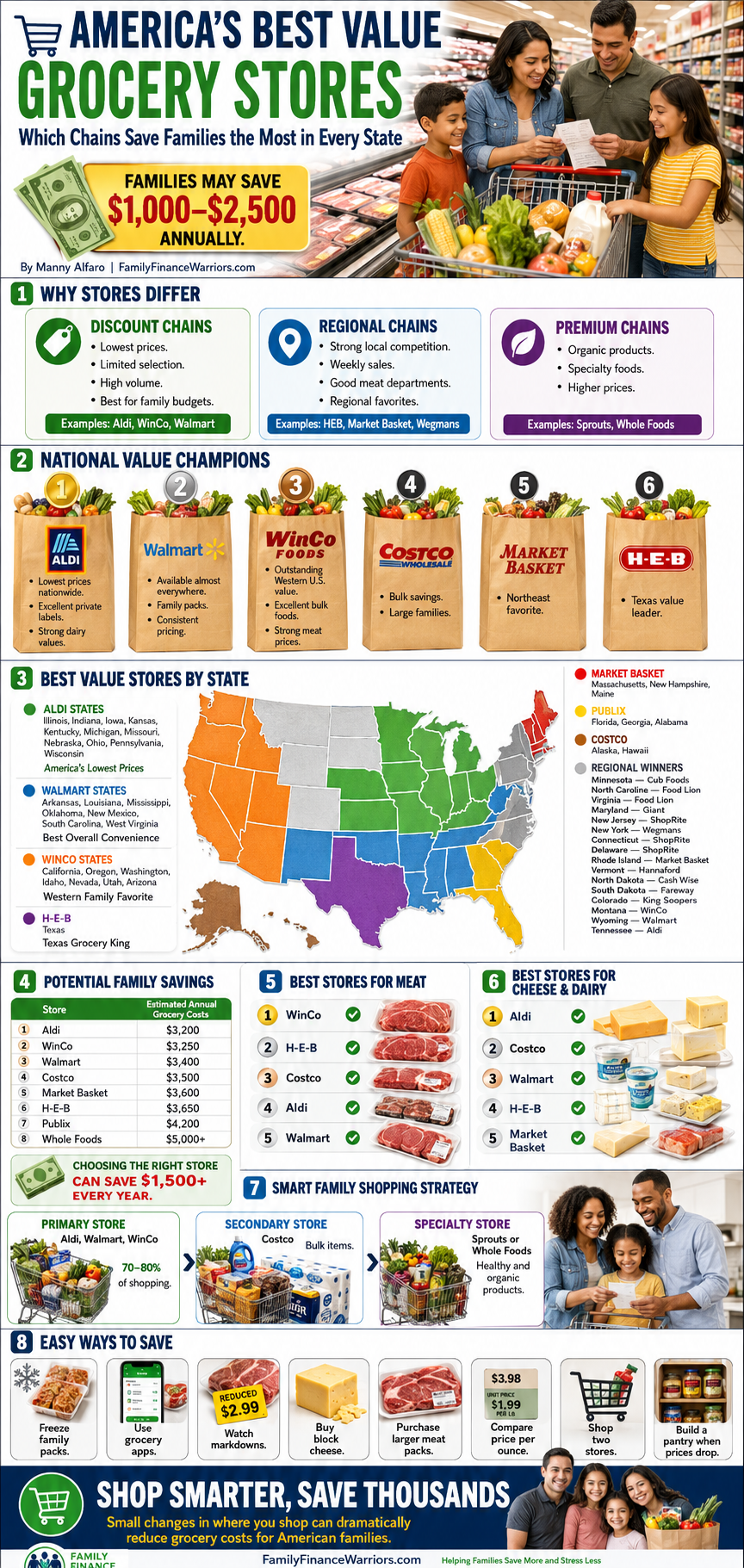
Food prices continue to challenge family budgets in 2026. While inflation has slowed compared to recent years, many families still feel the squeeze every time they buy groceries.
The good news? Where you shop matters just as much as what you buy.
Recent grocery pricing studies and consumer surveys show that families can save hundreds—and sometimes more than $1,000 per year—simply by choosing the right grocery stores for their everyday purchases.
Some chains consistently deliver excellent value on meat, cheese, milk, and pantry staples. Others focus on convenience, premium products, or organic selections that often come with higher prices.
This guide breaks down the best grocery stores in America for families, explains what makes each chain different, and shows how shoppers can save money without sacrificing quality.
Why Grocery Prices Vary So Much
Many families assume groceries cost roughly the same everywhere. In reality, pricing can vary dramatically.
Three major factors drive these differences:
Store business model
Product selection
Operating costs
Discount retailers focus on efficiency and lower overhead.
Traditional supermarkets offer larger selections and more services.
Premium grocery stores emphasize organic, natural, and specialty products.
These differences directly affect what families pay at checkout.
America's Best Grocery Stores for Families in 2026
🥇 Aldi
Aldi continues to be one of America's best values.
Why families love Aldi:
Extremely low prices
Excellent private-label products
Affordable dairy and cheese
High-quality meat selection
Fast shopping experience
Best for:
Budget-conscious families
Weekly staples
Dairy products
Meat purchases
🥈 Walmart
Walmart remains the price benchmark across much of the country.
Strengths include:
Low everyday prices
Huge selection
Family packs
One-stop shopping
National availability
Best for:
Large families
Meat purchases
Pantry staples
Convenience
🥉 WinCo Foods
WinCo operates primarily in western states but consistently ranks among the cheapest grocery stores.
Benefits:
Employee-owned company
Low operating costs
Excellent bulk foods
Affordable proteins
Strong dairy pricing
Best for:
Western families
Bulk purchases
Large households
Target
Target has become a surprisingly strong grocery competitor.
Advantages:
Good & Gather products
Target Circle rewards
RedCard savings
Clean shopping experience
Best for:
Busy families
Fill-in shopping trips
Household items
Costco
Warehouse clubs continue to deliver outstanding value.
Strengths:
Bulk meat purchases
Cheese and dairy savings
Rotisserie chicken
Family-sized packaging
Limitations:
Membership fee
Larger quantities
Storage space required
Kroger and Regional Chains
Kroger and its family of stores offer:
Excellent weekly sales
Digital coupons
Strong loyalty programs
However, regular prices can be higher than discount stores.
Sprouts Farmers Market
Sprouts serves a different type of shopper.
What makes Sprouts unique:
✅ Organic produce
✅ Grass-fed meat
✅ Natural foods
✅ Bulk bins
✅ Specialty products
Families often love Sprouts for:
Healthy eating
Organic ingredients
Specialty diets
Fresh produce
The tradeoff is price.
For conventional meat, cheese, and dairy, Sprouts often costs considerably more than Walmart, Aldi, or WinCo.
Whole Foods
Whole Foods remains one of the most expensive grocery options in many markets.
Its strengths include:
Premium products
Extensive organic selection
Specialty foods
Prepared meals
For many families, Whole Foods works best as an occasional store rather than the primary grocery destination.
How Much Can Families Save?
Consider a family spending $300 per month on meat and dairy.
Annual spending could look like this:
Store | Annual Cost |
Aldi | $3,456 |
Walmart | $3,600 |
Target | $3,850 |
Kroger | $4,050 |
Sprouts | $4,300 |
Whole Foods | $4,700 |
Choosing a lower-cost grocery store can save many families between $500 and $1,200 annually.
California Example: One of America's Most Expensive Grocery Markets
California provides an excellent example of how dramatically prices can vary.
Southern California shoppers often see:
WinCo and Aldi among the lowest prices.
Walmart near the middle.
Target slightly higher.
Ralphs, Vons, and Albertsons significantly higher.
Sprouts and Whole Foods among the most expensive.
Because California faces higher labor, transportation, and real estate costs, the price differences often become even more noticeable.
Many California families use a hybrid strategy:
Walmart, Aldi, or WinCo for staples.
Target for convenience.
Sprouts for specialty items.
The Best Hybrid Shopping Strategy
Smart families often divide their shopping.
Primary Store
Aldi, Walmart, WinCo, or Costco.
Purchase:
Meat
Cheese
Milk
Eggs
Pantry staples
Secondary Store
Target or local supermarkets.
Purchase:
Fill-in items
Household products
Sale items
Specialty Store
Sprouts or Whole Foods.
Purchase:
Organic products
Specialty foods
Health-focused items
This approach provides both savings and flexibility.
Easy Ways to Save More
Buy family packs.
Freeze extra meat.
Compare price per pound.
Buy block cheese.
Use store apps.
Watch for markdowns.
Use loyalty rewards.
Compare weekly ads.
Small changes can produce significant savings over time.
Which Grocery Store Is Best?
There is no perfect grocery store for every family.
For lowest prices:
🏆 Aldi
🏆 Walmart
🏆 WinCo
For convenience:
🏆 Target
For organic foods:
🏆 Sprouts
🏆 Whole Foods
For bulk shopping:
🏆 Costco
The best strategy is often using two or three stores based on your family's needs.
Final Thoughts
Families don't have to become extreme couponers to save money.
Simply choosing lower-cost stores for meat, cheese, and everyday staples can save hundreds or even thousands of dollars over time.
In 2026, the data is clear:
Aldi remains one of America's best values.
Walmart continues to provide excellent pricing.
WinCo delivers exceptional savings where available.
Sprouts offers quality and specialty foods at a premium.
Target balances convenience and affordability.
The smartest families focus less on loyalty to one store and more on buying the right products at the right places.
Your grocery budget—and your family finances—will thank you.
Continue Your Family Savings Journey
If you found this grocery savings guide helpful, these articles can help you save even more money and strengthen your family's finances.
🏠 15 Smart Family Money-Saving Hacks for 2026
Discover practical ways families are saving hundreds of dollars each month through meal planning, cashback apps, budgeting strategies, and low-cost family activities.
📱 Tech-Infused Frugal Living in 2026
Learn how budgeting apps, smart home devices, meal-planning tools, and technology can help families fight inflation and lower monthly expenses.
👉 https://www.familyfinancewarriors.com/post/ai-frugal-living-2026-budgeting-tools-smart-home-savings
💰 Top 25 Best Budgeting Apps and Websites for Families in 2026
Find the best budgeting tools for couples and families, including shared budgeting apps, savings trackers, and money management solutions.
At Family Finance Warriors, our mission is simple: help families save more, stress less, and build lasting financial security one smart decision at a time.



Comments